One of the first video game genres that I started out with was Real-Time Strategy games like Command & Conquer and Alpha Centauri before moving on to a genre which are now called Massively Multiplayer Online (MMO) games. One of the curious aspects about playing these games is that I almost always went for world dominion (e.g., take over the world). In the CnC era, this made sense, since really, you fought against the artificial intelligence (AI) or other players. So failure is not an option. Neither is negotiation or holding hands across the vast internet and singing Kumbaya. And actually, even as a girl scout, we have never sung Kumbaya, we always sung the Mosquito song or one that was called 'New Friend Found'.
Anyway, I digress. So. World dominion. This is in part due to the game design, and even as game design evolved, newer games in the genre like Civilization featured AIs which proved to be a REAL pain to maintain diplomatic ties with. Way worse than people. And I've always thought people were bad. Wait until you meet obtusely designed AIs, who will get mad at you if you even breathed near your borders. So. I'd have to shake many pointed sticks at them until the point gets across.
Which brings me to my point. And I do have a point somewhat. I actually despise the notion of conquest - you know, the kind that brings suffering to other human beings (like say, drones). This may have something to do with the fact that my people were always someone else's subject. But really, I'd like to think that it has something to do with being human. At a fundamental level, even when I'm playing games that feature specific themes such as conquest and establishing control by peacefully bringing light to the darkness (that's my favorite colonialist rhetoric), I know that this is not reality. And in some way, it's a way to direct my aggression and anger so that all the ugliness that is a part of me comes to the fore in another medium other than real life, where it will do actual harm. Don't get me wrong, there's a lot of harmful interactions in games, but that's a topic for another discussion.
Perhaps it's somewhat poetic that I met my husband online - where he has seen me at my worst. I always joke that gaming brings out the worst in me - but there's an element of truth in it. It's almost cathartic. And this is why I must play.

Tuesday, April 9, 2013


Wednesday, April 3, 2013
On privileging play
I have been thinking about the issue of privileging play and how it unfolds in different cultures, if at all. I recall stories of my father as a young child going heading out to the beach with his brothers, searching and foraging for snails or any molluscs that they can find. Dad seemed to enjoy himself immensely, and one might think that this event might be considered play from his perspective. However, the reality of the situation was that while it was fun, the reason why Dad was by the beach was to look for food.
In contrast, when talking to my late grandfather, I do not ever recall of him thinking of such activity as fun (he would scoff I think). This is largely because to Grandpa, actions that had no bearing on the future or others are nothing but indulgence. Don't get me wrong, he was a loving man who had a wry sense of humor. But his life experiences shaped his outlook on life. Life as a fisherman taking care of 8 children by himself (Grandma died when Dad was 6) was challenging, then life under/working with the British, then occupation under the Japanese... suffice to say, life was definitely eventful. No play is death some say ... but I do not believe that. Grandpa's life was fulfilling and he was happy and contented. Play may not be central to his life, but when one is focused on surviving, this is not unsurprising. I guess my point is to simply be careful of claims that we make about the necessity of play, less it tramples on the lives of others. It is an activity that may be definitive in some life courses, but not all. And to say that we all need play to survive sometimes does not feel right.
In contrast, when talking to my late grandfather, I do not ever recall of him thinking of such activity as fun (he would scoff I think). This is largely because to Grandpa, actions that had no bearing on the future or others are nothing but indulgence. Don't get me wrong, he was a loving man who had a wry sense of humor. But his life experiences shaped his outlook on life. Life as a fisherman taking care of 8 children by himself (Grandma died when Dad was 6) was challenging, then life under/working with the British, then occupation under the Japanese... suffice to say, life was definitely eventful. No play is death some say ... but I do not believe that. Grandpa's life was fulfilling and he was happy and contented. Play may not be central to his life, but when one is focused on surviving, this is not unsurprising. I guess my point is to simply be careful of claims that we make about the necessity of play, less it tramples on the lives of others. It is an activity that may be definitive in some life courses, but not all. And to say that we all need play to survive sometimes does not feel right.
Tuesday, March 26, 2013
Swim-time!
Hari ini, saya dan teman saya, Kate Shively pergi ke kolam air di SRSC. Ini adalah pertama kali semenjak saya pergi berenang, terutama sekali di negara Amerika Syarikat.
That was fun. I absolutely enjoyed being able to write in my native language, even if it was just two sentences, and something that I have not done in a while. I had asked my husband about inspirations on what to write for the blog and he said "Write something in Malay".
I laughed of course, thinking him silly, but then I thought about it. "Actually, I'll do it! Since I'm playing around with words and it's a completely valid way of writing! I'll write my first few sentences in Malay and then translate it! Or maybe create a game and ask my audience if they can figure out what I mean!"
So there you have it. I'm still pondering if I will provide a translation of the statements above, but for now, I'll have fun with it. If anyone's really curious and know Kate Shively, you could always ask her what we did tonight!
That was fun. I absolutely enjoyed being able to write in my native language, even if it was just two sentences, and something that I have not done in a while. I had asked my husband about inspirations on what to write for the blog and he said "Write something in Malay".
I laughed of course, thinking him silly, but then I thought about it. "Actually, I'll do it! Since I'm playing around with words and it's a completely valid way of writing! I'll write my first few sentences in Malay and then translate it! Or maybe create a game and ask my audience if they can figure out what I mean!"
So there you have it. I'm still pondering if I will provide a translation of the statements above, but for now, I'll have fun with it. If anyone's really curious and know Kate Shively, you could always ask her what we did tonight!
Tuesday, March 19, 2013
Meeting Iqra
"Hey Lina."
"Hmm?"
"So when am I meeting the kittens?"
"You gotta materialize for that to happen, and I am NOT calculating the wave function so you can be here."
"Blaaaaaah. Well what if I did the calculations ... would you do it then?" Iqra' looked at me imploringly as I pondered.
"Fine," I groused and laid out my equipment as Iqra' performed her mathematical derivations.
When Iqra' was finally done with her calculations, I proceeded to follow her scribbles.
"The kittens seem excited at the prospect of meeting me."

I grunted nonchalantly.
"You know, you need to be a little bit more careful with the materials. And remove that dastardly shiny thing. You are creating perfection."
I ignored her.
"Ugh, that color combination is terrible, Lina. How about ..."
I sighed in exasperation.
"Oookay. Somebody's grouchy... I guess I'll just wait Q-U-I-E-T-L-Y," whispers Iqra'.
The silence lasted all of two seconds and she began to speak
"I'm done," I interrupted her.
"Ooooh!! HI KITTIES!!!"


 |
| Viggo inspecting the equipment |
"So when am I meeting the kittens?"
"You gotta materialize for that to happen, and I am NOT calculating the wave function so you can be here."
"Blaaaaaah. Well what if I did the calculations ... would you do it then?" Iqra' looked at me imploringly as I pondered.
"Fine," I groused and laid out my equipment as Iqra' performed her mathematical derivations.
When Iqra' was finally done with her calculations, I proceeded to follow her scribbles.
"The kittens seem excited at the prospect of meeting me."

I grunted nonchalantly.
"You know, you need to be a little bit more careful with the materials. And remove that dastardly shiny thing. You are creating perfection."
I ignored her.
"Ugh, that color combination is terrible, Lina. How about ..."
I sighed in exasperation.
"Oookay. Somebody's grouchy... I guess I'll just wait Q-U-I-E-T-L-Y," whispers Iqra'.
The silence lasted all of two seconds and she began to speak
"I'm done," I interrupted her.
"Ooooh!! HI KITTIES!!!"


Sunday, March 17, 2013
Spontaneous play
In our chat earlier this week, my respondent made the distinction between spontaneous play as being social and intentional play as being directed and planned. Intentional play can be social in that friends decide to play together, but the nature of spontaneous play is more likely to arise from social interactions. This set me thinking about the nature of social play - is spontaneity more likely to occur or emerge as a result of the social interactions? Later, when I chatted with my respondent off the record, he noted that spontaneous play can most definitely emerge from planned play.
This reminds of me of Juul (2002), who identifies two basic game structures - emergence and progression. Games of emergence are based on simple rules and result in multiple variations that players can work with. Juul (2002) characterizes emergence in games as a result of rule interactions (i.e. A happens as a result of rule B), combination of rules and strategies that arise which are not immediately predictable from the game rules. Games of progression on the other hand, offer more control to designers in that players must proceed within a predefined framework in order to complete the game. Even as players proceed within a predefined framework or choose actions derived from simple rules, it is highly unlikely that designers can completely control players’ actions. This is especially pertinent given that players are able to modify both non-digital (i.e. board games) and digital games in many ways. In the former, players can change the rules of the game whereas in the latter, players create modifications to the software or hardware to execute functions that were not conceived by the original designers. While modifications are made by individuals, the changes to the rules impact normative structures and other social interactions, underscoring the social and communicative nature of games. While the description of play in my interview centered around types of play (e.g. spontaneous versus planned), it provided really useful insights into the changing nature of play - a theme that we have been encountering time and again.
This is of great interest to me given my design tendencies - what kinds of play would emerge from designed play? How would it align itself to the designed objective and how would players make sense of the discrepancies (if any) that may arise? Can we as designers create environments that might predict these sorts of emergent play?
This reminds of me of Juul (2002), who identifies two basic game structures - emergence and progression. Games of emergence are based on simple rules and result in multiple variations that players can work with. Juul (2002) characterizes emergence in games as a result of rule interactions (i.e. A happens as a result of rule B), combination of rules and strategies that arise which are not immediately predictable from the game rules. Games of progression on the other hand, offer more control to designers in that players must proceed within a predefined framework in order to complete the game. Even as players proceed within a predefined framework or choose actions derived from simple rules, it is highly unlikely that designers can completely control players’ actions. This is especially pertinent given that players are able to modify both non-digital (i.e. board games) and digital games in many ways. In the former, players can change the rules of the game whereas in the latter, players create modifications to the software or hardware to execute functions that were not conceived by the original designers. While modifications are made by individuals, the changes to the rules impact normative structures and other social interactions, underscoring the social and communicative nature of games. While the description of play in my interview centered around types of play (e.g. spontaneous versus planned), it provided really useful insights into the changing nature of play - a theme that we have been encountering time and again.
This is of great interest to me given my design tendencies - what kinds of play would emerge from designed play? How would it align itself to the designed objective and how would players make sense of the discrepancies (if any) that may arise? Can we as designers create environments that might predict these sorts of emergent play?
Wednesday, March 6, 2013
Playmates and being serious
Last night, I spent time with two of my dear friends who will be heading off to Wisconsin and start a new chapter of their lives. I will miss Ellen and Gabe, because just as much as their my friends, they are also my playmates! In fact, Ellen was the one who drew me into board games, and I have thoroughly enjoyed our game nights. Ellen and I also played a lot in Taekwondo - while many would think of Taekwondo as martial arts and serious - the fact that I enjoy it and simply love it seems more like play than work.
This brings me to the second part of my post - being serious. I'm not comfortable with terms like serious games, or serious play, mainly because if one adopts the perspective that play allows us to engage in flow - in all likelihood, that state of flow is very much real and serious. By attaching terms like serious to play and games, it detracts from what play actually is and even makes it less powerful. The strength in a definition of play is precisely because it isn't easily bounded (even as I do try to define it - yes, yes - humans do like to bound the world). I fear that by making claims of serious play/games, we signal to others that play was all along not serious and does not involve high stakes. This is not at all true in a lot of cases! There is a lot of risk-taking in play, and most players take it seriously.
But I digress ... I am mourning the loss of my playmates - BUT with technology, we are able to still play together online and I am very much looking forward to my play dates!
This brings me to the second part of my post - being serious. I'm not comfortable with terms like serious games, or serious play, mainly because if one adopts the perspective that play allows us to engage in flow - in all likelihood, that state of flow is very much real and serious. By attaching terms like serious to play and games, it detracts from what play actually is and even makes it less powerful. The strength in a definition of play is precisely because it isn't easily bounded (even as I do try to define it - yes, yes - humans do like to bound the world). I fear that by making claims of serious play/games, we signal to others that play was all along not serious and does not involve high stakes. This is not at all true in a lot of cases! There is a lot of risk-taking in play, and most players take it seriously.
But I digress ... I am mourning the loss of my playmates - BUT with technology, we are able to still play together online and I am very much looking forward to my play dates!
Tuesday, February 26, 2013
Flow and experience
Flow is defined as a "holistic sensation that people feel when they act with total involvement" (Csikszentmihalyi, 1975, pg. 36). If flow seems under-defined and seem intuitive, that is because the definition is based on native categories, or something that individuals identify themselves. To this end, flow is highly subjective and related to an experiential state. The essence of experience however, is that it can never be fully captured, which makes the issue of measuring flow highly problematic. Hegel (1977) aptly describes experience as being what we experience in the moment. In a particular moment, the properties of things can be said to be experienced by the senses, we experience the qualities of objects through this sensuous interaction with them. In contrast, the conception of ‘the uniqueness of the thing’ is an idea that develops independently of what is experienced of the thing. From this, one can assume that a thought is then the non-sensual component of experience.
To illustrate further, when a child first sees a red ball that she has never seen before, she experiences its properties. She immediately apprehends it; she apprehends the color red, the roundness of the ball, the smoothness of its texture, and so forth. She then develops a concept of the object as ball; a concept that is independent of all the properties previously encountered through the senses.
There are of course many interpretations of experience, but Hegel's phenomenological perspective sheds light on how a concept or definition of flow, or even play, is only part of the picture. I'm beginning to really like the notion of play as inherently contradictory (or dualistic if we must) since it is experienced in the moment-to-moment but only made sense of after the fact.
Tuesday, February 19, 2013
Pre-conditions of play
My husband and I have to work out a vacuuming schedule to accommodate Viggo, our 7-month old black striped tabby. Freya, our 5 month old is less affected, although she'll come hightailing to me to seek comfort when it's turned on. Our routine is simple; Ken will start with the upper level of the house (we live in a 3-storey townhome), whereas I'll sit in the basement and play with the cats. I then attempt to distract Viggo by playing with his favorite toys. Once the vacuum starts, he would still be interested in play but the sound would distract him to the point where he'd pause in the middle of play. If the vacuum comes closer (living room area on the first floor), poor Viggo would completely stop and that's our cue to hide in the closet together. Not because it's play, but because it makes him feel safe. Which brings me to the point of the post; a point that has been brought up in the class many times. Without a sense of safety, play is the first activity to go away. Indeed this was the case with our Viggo. We're pretty sure that some day that he'll be able to deal with the vacuum better (he hasn't had a panic attack since the first time he heard) but until then, maybe I can create a safe environment enough for him to play when the monster is turned on!


Tuesday, February 12, 2013
Un-play
This week's blog post is exactly the state that I am currently in. What is un-play? I'm honestly not sure, but it's definitely a state of 'un'. Don't get me wrong, I'm NOT in a state of not-play. On the contrary, I'm at the stage of my life when I'm so embroiled in thinking about play that when I have to actually sit down and write about it, I just stare at the screen. Like so. Part of it is because of the qualifying exams fast approaching next week, and the other is because I've just been thinking so much about it that it's difficult to put into words without writing an essay. For instance, my apprenticeship paper is to define play based on cognitive, biological and sociocultural learning theories. After which, I will work on designing play for learning. See why I can't keep my thoughts to just a paragraph? UN-PLAY (It's like saying unbelievable, just not.) A part of me is irritated at authors who claim that perspectives that try to define play narrows or limits the possibilities of play. For the purposes of learning and the culture accountability in education however, that is almost inevitable. Moreover, specializing does not necessarily mean that theorists are strapping themselves down. What's so terrible about committing oneself to a position? We all have our beliefs and perspectives. I think the key position to assume is to be candid about the assumptions that one has and to be clear about why one is using the approach. A defensible position - oh wait, I know what this is. I'm preparing for my defense subconsciously. Maybe? UN-PLAY!
Tuesday, February 5, 2013
Framing play and the nature of signs
Goffman (1974) proposed frames as basic elements of a situation, which consist both existing structures and is made sense of by an individual’s subjective perspective. In short, frames are ways of organizing experiences. From a Piagetian perspective, one would suggest that an individual’s existing conceptual frames or schemas help her make sense any given situation. These frames then influence the individual’s next actions. From a Vygotskian perspective; an individual’s interpretations of contextual frames are based on social and cultural formations. These frames however only make sense in-so-far as the individual recognize the meaning of these frames and is able to not only act upon them but to communicate the meaning of this frame. The idea of frames can help us make sense of play; play as an inclusive intersubjective state or a mutual recognition of the situation. For play to be recognized between individuals, they have to have a shared experience; the actions undertaken by another person in this situation are understood within the specific play frame. It stands to reason that symbolic competence is insufficient without an understanding of how actions also require a response from another (Mead, 1967). Similarly, when participants engage in play, the recognition from the participants that they are playing is paramount. Play is determined by the participant(s). Moreover, symbolic competence allows children to understand social cues and is necessary for children to determine what constitutes play. In order for play to be recognized, children need to be able to understand signals, that is, to reflect upon their actions and recognize that actions undertaken are signals or symbolic representations (Bateson, 1972). I am still thinking about the nature of signs and symbols with respect to play and am hopeful to examine this further in the next few weeks.
Tuesday, January 29, 2013
On ontologies and the dialectical dualism of play
I was reflecting on Mary's response to my stance on the nature of rhetorics (and play). Ontologically, I am deeply committed to a dialogic interaction between consciousness and the material world. It is not monistic and very much accepts the dualism of the two concepts as representative of existence. However, even as one accepts the dualism of existence, there are those who try to understand the world from a material perspective (e.g. Marxists, CHAT theorists) and others who seek to do so from consciousness (e.g. phenomenologists). My theoretical commitment is very much aligned to the work of Hegel who then influences the succession of theorists who have had an impact in my thinking: Marx, Vygotsky, Luria/Leon'tev and Engestrom. To this end, I have a deep appreciation of a materialist perspective (in my past life, I was a sociologist). Having said that however, I also believe that language plays a key role in. In the cultural-historical activity theory tradition, language takes on the role of a master tool. However, language is more essential than the role that it has been given. If practice is the core of human activity, then communication (or language) is the other side of the coin that makes it possible. Communication or language is what we think in, and praxis is the act that may or may not express our thoughts.
How does this relate to play? Judging from the dichotomies and the discussion that we have had on binaries, play is the very essence of dualism - it is real/unreal, it is serious/fun, it is the whole but it is also the parts. In play, we have praxis and also communication (internal speech or social as Vygotsky would put it). Given that our praxis is the very expression of our selves, it is no wonder that play is so ambiguous. The nature of the self is highly adaptable and flexible. When we try to express ourselves, at times, we are just not able to do so. Here I think about Goffman's work about how we present ourselves in different situations, or Mead's abstract other, or Cooley's looking glass self. We act based on our certainty, as Hegel would put it, and based on what we perceive others would understand. It is only through a response from another person that we can assume that there is some sort of intersubjectivity (or lack thereof). Most notably, play is not play until we reflect on it or receive a sign from someone that indicates play (I need to talk about signs as some point!!). Much like learning, that moment of reflection is crucial. Perhaps this is why we do not think of play as part of our lives. When we are having an experiential state of play, it is a moment of just being. We only label it as such afterwards. I am reminded of the experiences of my peers about having to play. Thinking or being tasked to play seems antithetical to the experience of play. As for my own experiences, play is integral. Even in moments when I am tasked to write, word play (even though I am not good at it) is wonderful, much like an activity of reading.
Note: I apologize for the lack of cites, it's a stream of consciousness right now (later, as I reflect on the blog writing activity, I will say that it is play but in the actual moment-to-moment writing, there are moments of play and not play!)
How does this relate to play? Judging from the dichotomies and the discussion that we have had on binaries, play is the very essence of dualism - it is real/unreal, it is serious/fun, it is the whole but it is also the parts. In play, we have praxis and also communication (internal speech or social as Vygotsky would put it). Given that our praxis is the very expression of our selves, it is no wonder that play is so ambiguous. The nature of the self is highly adaptable and flexible. When we try to express ourselves, at times, we are just not able to do so. Here I think about Goffman's work about how we present ourselves in different situations, or Mead's abstract other, or Cooley's looking glass self. We act based on our certainty, as Hegel would put it, and based on what we perceive others would understand. It is only through a response from another person that we can assume that there is some sort of intersubjectivity (or lack thereof). Most notably, play is not play until we reflect on it or receive a sign from someone that indicates play (I need to talk about signs as some point!!). Much like learning, that moment of reflection is crucial. Perhaps this is why we do not think of play as part of our lives. When we are having an experiential state of play, it is a moment of just being. We only label it as such afterwards. I am reminded of the experiences of my peers about having to play. Thinking or being tasked to play seems antithetical to the experience of play. As for my own experiences, play is integral. Even in moments when I am tasked to write, word play (even though I am not good at it) is wonderful, much like an activity of reading.
Note: I apologize for the lack of cites, it's a stream of consciousness right now (later, as I reflect on the blog writing activity, I will say that it is play but in the actual moment-to-moment writing, there are moments of play and not play!)
Wednesday, January 23, 2013
The nature of rhetorics
A crucial aspect of mapping the questions that we had thought up in class was to question the underlying assumptions about the questions. This was not at all easy, given that I had to take on the perspective of the person who was writing the question. Indeed, if one were to think of this intersubjective stance from a particular frame, one can argue that I was playing with ideas; taking on the role of abstract peers and questioning their worldviews. This then led me to ponder about the Sutton-Smith's (2001) rhetorics and the assumptions embedded in each category. He characterizes play rhetorics as those that include “broad symbolic systems - political, religious, social, and educational” (2001, p. 9). Here, rhetoric highlights various discourses, narratives and values that members of a particular discipline align themselves to. Rhetorics are thus drawn from larger sociocultural systems that individuals are a part of. These rhetorics are therefore ideological ways of thinking about play which he separates from more scientific or personal rhetorics. At the core of a rhetoric is also ontological and epistemological assumptions. For instance, what kind of stance do developmental or animal theories adopt? A person who assumes a constructivist stance could think of the mind as paramount and therefore focus on imaginary play as more salient construct than say physical play. Questioning and understanding our assumptions about the nature of play is therefore integral to defining play. Of course the term definition itself may have different ontologies. For instance, does a definition need to have set properties? Or is it dialectical? Or is it contextual?
An act of play therefore contains several assumptions of what play is; both to the organism playing and to the observer. This is an age-old debate about the nature of knowledge (epistemology). Do we try to know knowledge from a third person perspective, or do we try to capture it from the emic perspective? What forms of knowledge is valid? Are subjective states a useful way in determining play? Or are we looking for general characteristics? For me, play is necessarily intersubjectively derived. If one has to define play, it has to be a consensus that participants agree to before, during or even after the fact. This is however, not entirely easy to ascertain, particularly if we as researchers have to glean such information from participants (sometimes, it's not feasible). In playing a video game with other people for instance, the assumption is that everyone engaging in the activity is actually playing. This assumes that play is a continuous state, but is it always so? If one breaks away from the play (like when my cats distract me), is it still play? There are ways to ascertain this from a third person perspective such as drawing some general observable characteristics but it may be unclear unless the researcher engages in conversation with the participants. The frame that participants bring to these contexts are paramount in understanding what play means to them inasmuch as the observed characteristics. This then raises multiple questions for me (more of them!), questions that can only be answered empirically given the worldview and theoretical perspective that I adopt in relation to what play is.
An act of play therefore contains several assumptions of what play is; both to the organism playing and to the observer. This is an age-old debate about the nature of knowledge (epistemology). Do we try to know knowledge from a third person perspective, or do we try to capture it from the emic perspective? What forms of knowledge is valid? Are subjective states a useful way in determining play? Or are we looking for general characteristics? For me, play is necessarily intersubjectively derived. If one has to define play, it has to be a consensus that participants agree to before, during or even after the fact. This is however, not entirely easy to ascertain, particularly if we as researchers have to glean such information from participants (sometimes, it's not feasible). In playing a video game with other people for instance, the assumption is that everyone engaging in the activity is actually playing. This assumes that play is a continuous state, but is it always so? If one breaks away from the play (like when my cats distract me), is it still play? There are ways to ascertain this from a third person perspective such as drawing some general observable characteristics but it may be unclear unless the researcher engages in conversation with the participants. The frame that participants bring to these contexts are paramount in understanding what play means to them inasmuch as the observed characteristics. This then raises multiple questions for me (more of them!), questions that can only be answered empirically given the worldview and theoretical perspective that I adopt in relation to what play is.
Tuesday, January 15, 2013
The dialectics of play
I had originally titled this post, the duality of play but as I began writing, the notion of a duality can be problematic because play is neither simply about mind play (e.g. imaginary play, strategy play) nor physical play (e.g. sports) but instead straddles between the two. In this regard, play can be regarded as liminal - it is the in-between. In Hegelian terms, play involves a dialectical process. In some moments, it is enjoyable, in others, one may be frustrated, it can be serious but it can also be for fun. Thus, Sutton-Smith's (1997) astute observations on the difficulty of defining and understanding play is well-aligned with the multiple instantiations of play research such as that in biology, anthropology and sociology. In the field of learning sciences, much of play has been attributed to Vygotsky and Piaget's theories of cognitive development. In this regard, my fascination with play has always been about the processes of learning, or in some cases, why people don't learn.
From the age of 10, I have been an avid video gamer. I would go over to my friend's house just to play their Nintendo or Sega games, and just generally to hang out. When I entered secondary school, I would do the same, except it would be the computer. The interest in learning developed much later on when I first built my personal computer at 17. The family could finally afford one and it was a glorious day indeed! From playing with friends who are physically around, I then moved to making friends online by playing real-time strategy (RTS) and role-playing games (RPG). My obsession with playing games in part started out as beating the artificial intelligence (AI) or the game itself, never mind that the odds are usually stacked against you depending on the difficulty level. I was thus very competitive and strove to be the best. If one were to subscribe to Richard Bartle's taxonomy of type of players, I would place myself within the achievement camp.
Once I started playing multiplayer online games (MMOGs, though they weren't coined yet at the time), I began to notice how certain players just seem unable to learn from their past encounters in the content, no matter how many times they tried! This really baffled me - I could not understand what was so difficult about generalizing principles or strategizing moves in order to beat the encounter (be it a boss or another player). This was often extremely frustrating as well since the nature of MMOGs meant that you have to depend on other people in order to achieve your aims. Finding 39 other skilled individuals was a chore at best.
Thus began my journey into trying to understand why individuals get 'good' at certain skills while others seem to struggle. On the other hand, there were also the social rhetoric and commentary about video game vice. Studies abound were making connections between video game violence and real life violence, all the while not taking into account the complex environment that human beings live in. Growing up within the culture of 'video games are bad', I was adamant to demonstrate that this simplistic causal claim is unwarranted and unsubstantiated. I was just as well-adjusted as any other outgoing teenager. So were my friends, some of whom are dedicated parents and what society would consider 'normal'. This cultural perspective of video games frustrated me, in part because my parents were of the opinion that video games were a waste of time.
These cultural norms and ideologies reminded me greatly of how play is generally thought of. Play after all has sometimes been described as only for children insofar as it keeps them occupied. Compared to work, where the outcome is certain and one can measure productivity, play is ambiguous. It can be serious, but it can be playful. Play, as Bateson (1972) argues, involves a situation where an an act of play can be communicated at two or more levels at once. Take for instance when human beings joke with one another. At one level, there is the joke, or the fact that one is horsing around. But on another level, there may also be a serious commentary behind the joke or at least another meaning of what the joke can take on. This capacity for meta-communication means that the playing organism is able to communicate to another participant what “is” and what “is not”, which suggests that play involves paradoxical communication (Nachmanovitch, 2009). I believe that this paradox is due to the dialectical nature of play and is inherent in it as a construct, which could explain the different interpretations that researchers have of it and why it is so difficult to pin down. As a starting point however, play is dialectical in that it is a continuum of experiences and that each moment of play sublates the moments before it. Play, in a sense, is also a frame that we bring to a particular context which already has it own existing frame. Using Goffman's (1974) definition, a frame contains the basic elements of a situation, which consist both existing structures and is made sense of by an individual’s subjective perspective. It is thus the meeting of the two (our own frame and the current context) that creates the paradoxical nature of play. In the next few weeks, I hope to develop these ideas further and explore more of how the paradox of play relates to learning.
From the age of 10, I have been an avid video gamer. I would go over to my friend's house just to play their Nintendo or Sega games, and just generally to hang out. When I entered secondary school, I would do the same, except it would be the computer. The interest in learning developed much later on when I first built my personal computer at 17. The family could finally afford one and it was a glorious day indeed! From playing with friends who are physically around, I then moved to making friends online by playing real-time strategy (RTS) and role-playing games (RPG). My obsession with playing games in part started out as beating the artificial intelligence (AI) or the game itself, never mind that the odds are usually stacked against you depending on the difficulty level. I was thus very competitive and strove to be the best. If one were to subscribe to Richard Bartle's taxonomy of type of players, I would place myself within the achievement camp.
Once I started playing multiplayer online games (MMOGs, though they weren't coined yet at the time), I began to notice how certain players just seem unable to learn from their past encounters in the content, no matter how many times they tried! This really baffled me - I could not understand what was so difficult about generalizing principles or strategizing moves in order to beat the encounter (be it a boss or another player). This was often extremely frustrating as well since the nature of MMOGs meant that you have to depend on other people in order to achieve your aims. Finding 39 other skilled individuals was a chore at best.
Thus began my journey into trying to understand why individuals get 'good' at certain skills while others seem to struggle. On the other hand, there were also the social rhetoric and commentary about video game vice. Studies abound were making connections between video game violence and real life violence, all the while not taking into account the complex environment that human beings live in. Growing up within the culture of 'video games are bad', I was adamant to demonstrate that this simplistic causal claim is unwarranted and unsubstantiated. I was just as well-adjusted as any other outgoing teenager. So were my friends, some of whom are dedicated parents and what society would consider 'normal'. This cultural perspective of video games frustrated me, in part because my parents were of the opinion that video games were a waste of time.
These cultural norms and ideologies reminded me greatly of how play is generally thought of. Play after all has sometimes been described as only for children insofar as it keeps them occupied. Compared to work, where the outcome is certain and one can measure productivity, play is ambiguous. It can be serious, but it can be playful. Play, as Bateson (1972) argues, involves a situation where an an act of play can be communicated at two or more levels at once. Take for instance when human beings joke with one another. At one level, there is the joke, or the fact that one is horsing around. But on another level, there may also be a serious commentary behind the joke or at least another meaning of what the joke can take on. This capacity for meta-communication means that the playing organism is able to communicate to another participant what “is” and what “is not”, which suggests that play involves paradoxical communication (Nachmanovitch, 2009). I believe that this paradox is due to the dialectical nature of play and is inherent in it as a construct, which could explain the different interpretations that researchers have of it and why it is so difficult to pin down. As a starting point however, play is dialectical in that it is a continuum of experiences and that each moment of play sublates the moments before it. Play, in a sense, is also a frame that we bring to a particular context which already has it own existing frame. Using Goffman's (1974) definition, a frame contains the basic elements of a situation, which consist both existing structures and is made sense of by an individual’s subjective perspective. It is thus the meeting of the two (our own frame and the current context) that creates the paradoxical nature of play. In the next few weeks, I hope to develop these ideas further and explore more of how the paradox of play relates to learning.
Sunday, November 13, 2011
Technological equity
One of the key concerns about the use of technology is whether it is able to serve all populations of people in such a way that it allows them to achieve valuable functionings (Sen, 1984). I won't go into detail into Sen's argument here, since I am using capability approach as a way to discuss Warschauer's (2008) analysis of the digital divide.
So what does economics have to do with technology? If one were to use Warschauer's (2008) argument that lack of access to information and communication technology (ICT) is a causal factor in impoverishment, then it is clear that technological access impacts economical well-being, and in turn, an individual's quality of life. However, an understanding of access has to include factors other than physical or infrastructural capabilities. For instance the Enhancing Education Through Technology (EETT) report highlights how physical, digital, human and social resources interact in order to address the issue of access. While the report acknowledges the role of social resources, there was no analysis regarding the forms of support available for students and teachers. Student literacy was also not examined since it was not within the scope of the report. Thus, although the report presented some useful trends, it did not allow us to understand how students and teachers are using ICT or their capabilities. This gap is arguably bridged by Warschauer (2008), who offers evidence of how technology is used unequally by students of low and high socioeconomic status. Volman and van Eck (2001) on the other hand, offer a further nuanced overview of inequity by including a discussion of how technology impacts gender. In contrast to Warschauer, these authors argue for a fine-grained understanding of use of specific ICT applications according to students' approach towards ICT use, their level of participation and outcomes of this participation.
 In terms of my model, I have focused primarily on Warschauer (2008), as well as Volman and Eck's (2001) articles as a way of expressing how certain factors can impact access, and in turn one's level of participation, approach and outcomes. At the micro-level, one can examine the teacher-student-object interaction, whereas the expanded aspects of the interactions include other factors that impact these interactions. To date, I have not made changes to the basis of the model since several revisions ago, primarily it serves its function as a theoretical model that explains interactions between actors within the structures of the world.
So what does economics have to do with technology? If one were to use Warschauer's (2008) argument that lack of access to information and communication technology (ICT) is a causal factor in impoverishment, then it is clear that technological access impacts economical well-being, and in turn, an individual's quality of life. However, an understanding of access has to include factors other than physical or infrastructural capabilities. For instance the Enhancing Education Through Technology (EETT) report highlights how physical, digital, human and social resources interact in order to address the issue of access. While the report acknowledges the role of social resources, there was no analysis regarding the forms of support available for students and teachers. Student literacy was also not examined since it was not within the scope of the report. Thus, although the report presented some useful trends, it did not allow us to understand how students and teachers are using ICT or their capabilities. This gap is arguably bridged by Warschauer (2008), who offers evidence of how technology is used unequally by students of low and high socioeconomic status. Volman and van Eck (2001) on the other hand, offer a further nuanced overview of inequity by including a discussion of how technology impacts gender. In contrast to Warschauer, these authors argue for a fine-grained understanding of use of specific ICT applications according to students' approach towards ICT use, their level of participation and outcomes of this participation.

Tuesday, November 1, 2011
Virtual worlds
Ah, virtual worlds. The key argument put forth by Steinkuehler & Duncan (2008), Neulight et al (2007) and Hudson & Degast-Kennedy (2009) is that the learning (be it content, dispositions, etc.) gained from virtual worlds is potentially transferable to real life learning situations. Steinkuehler & Duncan (2008) argue that scientific habits of mind may occur in the wild while Neulight et al (2007) demonstrate that designing for virtual worlds can be beneficial for students but remain challenging for learning. Regardless of methodological issues present in the former study, it stands to reason that some players engage in scientific literacies. A bigger question for me is thus who is participating, since it may very well be that only interested players would visit such forums in the first place, as opposed to a classroom environment where students have limited choice in their participation. This is not to say that the students did not enjoy Whyville, although there seemed to be healthy skepticism among the participants in Hudson & Degast-Kennedy's (2009) study.
What does this all mean for educators and researchers interested in using such technologies in the classroom? For me, the big takeaway from these authors is the role of the teacher and curricular design. Neulight et al (2007) highlighted that learning gains are impacted by these two factors, a message that I think is consistent across all the literature read thus far. Nardi and O'Day will certainly agree that in order for effective learning to occur, educator must understand how individual components of a learning ecology interact. To this effect, my model remains unchanged, but I have illustrated the model with problematic components to illustrate why learning gains in the Neulight study were superficial. Through this illustration, I hope to present justification as to why taking into account components of the model is necessary for learning and demonstrate the usefulness of the current model.


Monday, October 17, 2011
Computational literacies
If there are multiple views on what counts as literacy, there seems to be a range of views on what counts as computational literacies in the fields of science, media and computing. While not specifically focused on the notion of computational literacies, Peppler & Kafai (2007) recognize that youths must be able to participate in new media cultures by "learning the [necessary] visual, semiotic, aural and technological literacies" (pg. 5). Scratch, a programming tool, presents opportunities for youths to participate by creating digital productions. One can argue that the representational form underlying the literacies being supported by Scratch is concrete in nature, as opposed to the abstractions underlying diSessa's (2000).
Wing (2008) characterizes the ability to operationalize abstractions and understand the relationships across multiple layers of abstraction as computational thinking, or arguably, as computational literacy. He contends that this form of computational thinking is useful across multiple disciplines such as economics and biology. Such a claim however, needs to take into account the basis of the representational forms that underlie specific genres and their social niches (diSessa, 2000). But what exactly is the representational form that underlie computational thinking or Boxer for that matter (Sandoval, 2001)? Could the box model, even if abstract, serve as a basic notation system that can affect other genres and social niches? How does abstraction work as a principle, and is there an underlying model that we can use to understand different forms of media? How does abstraction help us understand the fundamental representational form of Scratch, which is quite concrete?
To address these questions, it is perhaps useful to take into account what abstract and concrete representations do for learners. It may very well be that abstract forms of representations may be instrumental for experts, whereas novices learn better with concrete forms of representations, but a combination of both concrete and abstract is arguably present in both Scratch and Boxer. The degree of abstraction and concrete however varies tremendously, largely because there is no single model that informs the creation of notation systems. I'm unsure as to whether this interpretation is valid, and more thinking is definitely required to make sense of literacy in general.
In terms of the model, diSessa's pillars of literacy can be embedded as part of the lifeworld; the material, social and cognitive aspects of literacy is relevant to how individuals think about being literate and how objects are imbued with these affordances. Note that the 3 aspects of literacy maps on to Bourdieu's (1986) forms of capital; economic, social, cultural (note that individual disposition or habitus is a culmination of these 3 factors according to Bourdieu). I have not changed the basic design of the model, but have instead used the model to illustrate how one may think about literacy by using the model.

Wing (2008) characterizes the ability to operationalize abstractions and understand the relationships across multiple layers of abstraction as computational thinking, or arguably, as computational literacy. He contends that this form of computational thinking is useful across multiple disciplines such as economics and biology. Such a claim however, needs to take into account the basis of the representational forms that underlie specific genres and their social niches (diSessa, 2000). But what exactly is the representational form that underlie computational thinking or Boxer for that matter (Sandoval, 2001)? Could the box model, even if abstract, serve as a basic notation system that can affect other genres and social niches? How does abstraction work as a principle, and is there an underlying model that we can use to understand different forms of media? How does abstraction help us understand the fundamental representational form of Scratch, which is quite concrete?
To address these questions, it is perhaps useful to take into account what abstract and concrete representations do for learners. It may very well be that abstract forms of representations may be instrumental for experts, whereas novices learn better with concrete forms of representations, but a combination of both concrete and abstract is arguably present in both Scratch and Boxer. The degree of abstraction and concrete however varies tremendously, largely because there is no single model that informs the creation of notation systems. I'm unsure as to whether this interpretation is valid, and more thinking is definitely required to make sense of literacy in general.
In terms of the model, diSessa's pillars of literacy can be embedded as part of the lifeworld; the material, social and cognitive aspects of literacy is relevant to how individuals think about being literate and how objects are imbued with these affordances. Note that the 3 aspects of literacy maps on to Bourdieu's (1986) forms of capital; economic, social, cultural (note that individual disposition or habitus is a culmination of these 3 factors according to Bourdieu). I have not changed the basic design of the model, but have instead used the model to illustrate how one may think about literacy by using the model.

Tuesday, October 4, 2011
Mobile technologies
Mobile technologies are powerful tools that allow individuals to immerse themselves into authentic scientific inquiries that will potentially lead to learning (Colella, 2000; Klopfer, Yoon & Rivas, 2004; Squire & Klopfer, 2007). While virtual learning environments may allow learners to explore these spaces through the use of an avatar, by interacting with simulations or with instructing teachable agents, learners are confined in a physical space, usually the computer laboratory. Colella (2000) notes that participatory simulations, or "life-sized, computer-supported simulations" (pg. 471) are microworlds that have underlying rules that constrain a user's actions. Participatory simulations moreover allow students to construct an understanding of the world by using their intuitions (Klopfer, Yoon & Rivas, 2004) and create a safe space where students can potentially learn from their failures (Squire & Klopfer, 2007). While the potential of mobile technologies are important, the lack of feedback and scaffolding may impact students' learning, as demonstrated by Squire and Klopfer (2007). While the idea of a sandbox may be interesting, free play in participatory simulations is arguably similar to the concept of pure discovery learning, where students receive no guidance from the instructor (cf. Mayer, 2004). In contrast, Colella's (2000) analysis of the disease simulation underscores the importance of framing these activities in a way that students are able to make sense findings although there was no analysis of the impact of researchers and facilitators in guiding student understanding. Regardless of these findings, mobile technologies can indeed be powerful learning tools, if designed carefully.
With this in mind, I have not updated the old model, because I believe that it is still able to explain the interactions within this particular system/ecology. However, I have explicated certain aspects of the model and created two separate Participatory Simulation models which illustrate the interactions between students. In particular, I used Bourdieu's (1986) concept of capital to explain how aspects of our lifeworld or our interpretations of our experiences are influenced by not only by our individual characteristics but also by other structures that exist independent of us (e.g., economy, educational qualifications, class, race, gender, etc.). This is a vital component to explicate because our interactions with others and objects are influenced by our lifeworlds, but the lifeworld is also changed through our interactions with others and objects. Objects themselves are not value-free; what we see of things in the world dictate how we interact with them. The designed mobile technologies for instance are value-laden objects that have to be unpacked by students. At the same time, the role of the instructor cannot be taken out of any learning situation, if one wants to achieve better learning (see model 3.2).
 |
| Model 3.1 |
With this in mind, I have not updated the old model, because I believe that it is still able to explain the interactions within this particular system/ecology. However, I have explicated certain aspects of the model and created two separate Participatory Simulation models which illustrate the interactions between students. In particular, I used Bourdieu's (1986) concept of capital to explain how aspects of our lifeworld or our interpretations of our experiences are influenced by not only by our individual characteristics but also by other structures that exist independent of us (e.g., economy, educational qualifications, class, race, gender, etc.). This is a vital component to explicate because our interactions with others and objects are influenced by our lifeworlds, but the lifeworld is also changed through our interactions with others and objects. Objects themselves are not value-free; what we see of things in the world dictate how we interact with them. The designed mobile technologies for instance are value-laden objects that have to be unpacked by students. At the same time, the role of the instructor cannot be taken out of any learning situation, if one wants to achieve better learning (see model 3.2).
 |
| Model 3.2 |
The elaboration of lifeworlds moreover, is useful when one tries to understand how a female student would approach mobile technologies, in contrast to a male student. Note that the outcome of such interactions affect our ways of thinking and being, which can be thought of outcomes or goals for a given activity. Using Klopfer, Yoon and Rivas' (2004), findings about increased students learning, the model illustrates that despite an apparent difference in attitudes towards games, females experienced learning gains, comparable to their their male counterpart, as illustrated in model 3.3. Thus, we are able to focus on aspects of the object or activity design that may have resulted in this gain. Currently, the model is unable to pinpoint the various aspects within the system/design that has to be changed, but given that its focus is on the interactions between individuals and objects, perhaps another model or revision may be in order. Suggestions and feedback regarding this is welcomed!
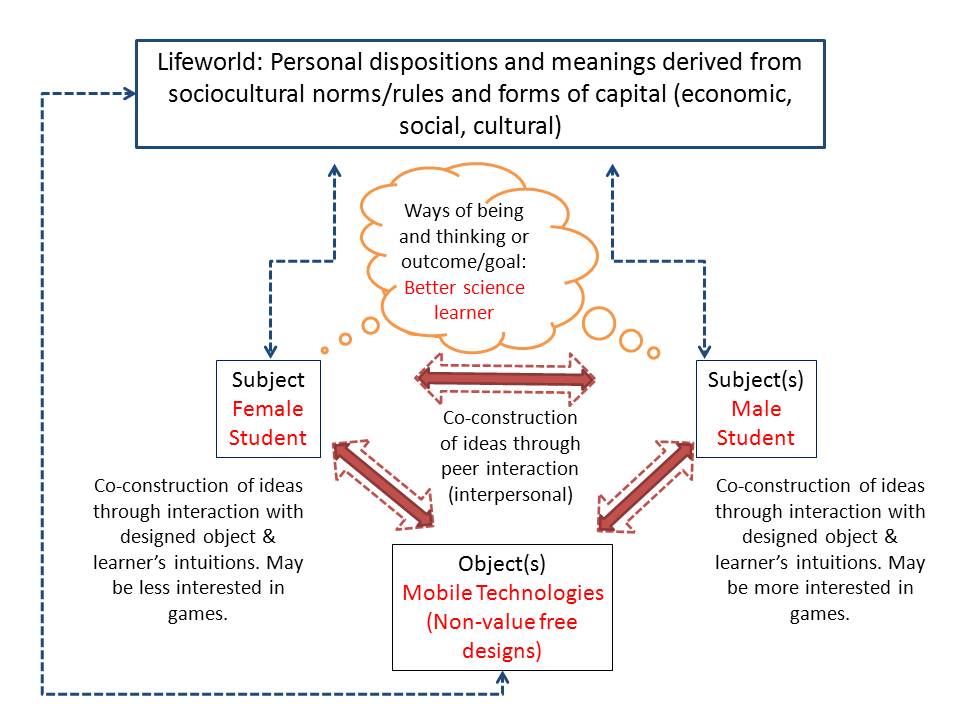 |
| Model 3.3 |
Monday, September 19, 2011
From the macro to the micro

Given the interplay between the agency-system and mind-social dichotomies that arise in these articles, I have sought to revise my model by acknowledging that the nature of the lifeworld as inter-subjective, in which experiences are social in nature and can be shared with others. For instance, the interaction between peers and/or teachers are intersubjective in that each party comes with their own interpretation of the situation and affect each other's interpretation of the situation before them (recall Schwartz et al.'s example of the mother and child interaction). In some student interactions with technological designs on the other hand, students are in effect interacting with the embedded intention of the designer (e.g., cognitive tutors). Successful learning as such, depends on the perceived affordances of the designed technology. Perceptions of affordances however, are drawn from the lifeworld, as well as the presence of others. As noted by all the authors, successful use of the technology used in the classroom depended on social interactions with peers and teachers.
As I reflect on the model further however, perhaps there should actually be another thought-bubble that arises from the subject-object interaction, since this interaction affects how each would be thinking/thought of. Here, objects are taken to mean as artifacts that are imbued with cultural meanings drawn from one's lifeworld. They are thus not neutral, but instead imbued with a variety of meanings. Admittedly, the model is still general, but does capture the various aspects that are important in understanding the role of subject and objects in relation to the lifeworld (structures and systems included!).
Monday, September 5, 2011
Person-Lifeworlds-Technology versus Information Ecologies
A common theme among the three papers was the nature of technological affordance and in particular, how these affordances depend on the interaction potential of users (Stahl & Hesse, 2009). Interaction potential in this sense refers to users' ability to perceive the constraints and possibilities in the activity and environment (Gibson, 1977). This echoes the other authors' argument that a shift of perception is necessary in order to understand technology and for users to be critical and reflective of the corpus of information found in information ecologies, as well as being aware of the invisible practices and working styles present in such ecologies (Burbules & Callister, 1999; Nardi & O'day, 2000).
The original model I had about the role of technology in education leveraged affordances as a heuristic about how to think about the role of technology in our lives. It was general, and purposefully so, since I wanted to focus on the dialectical interaction between person and environment, as well as what Husserl (1936) characterizes as our lifeworld. While the concept of lifeworld is complex, I use it here to represent both one’s personal attitudes and the sociocultural established meanings given to experiences and/or interactions with objects or persons in the world.
In the updated model, I have chosen to specify the components of the interactions among individuals, their lifeworlds and technology. This model mirrors Nardi and O'Day’s (2000) concept of information ecologies to a certain extent. Nardi and O’Day make a compelling argument for the concept of information ecologies; local environment with various practices, values, technologies and people. These ecologies encapsulate the three metaphors or holistic assumptions and questions regarding technology as tools, texts, and systems.
 To illustrate this model, I have selected the gaming ecology in a World of Warcraft raid instance. The raid instance represents the technological world of an online gaming environment, complete with various tools and interactions with others which are necessary for the success of any given encounter. Players must not only know how to use the material aspects of the technology, but must also pay attention to the interpretation and meaning of symbols embedded in the local environment, which functions as an enclosed system. Simply put, a person's interaction with the designed game environment (which represents technology) is informed by her lifeworld, which in turn affects her gameplay and the uptake of the technology. This lifeworld can consist of the norms associated with what it means to play a certain class, the practices associated with the group that one belongs, but can also be affected by the lifeworld of others. On the other hand, the existence of the designed game environment presents constraints and affordances and thus changes how people interact with one another.
 |
| Model Version 1.0 |
 |
| Model Version 2.0 |
Much like information ecologies, the concept of lifeworld allows us to understand the impact of lifeworld on individuals and can be further operationalized into the existing material and symbolic aspects of the human condition. Drawing on this model, the interaction between person-lifeworld-technology can impact one’s use of material technology (as a tool) and the intention and symbolic meaning embedded in these interactions (as text) and represents the magnitude and scale of the role of technology in our lives (as a system). Nardi and O'Day presented a good overview of the complexities involved in the idea of systems, but I found it undefined and problematic since it did not seem as if the ideas were synthesized usefully. I have chosen here to define system as the replicated relations between actors which are in turn structured as social practices (Giddens, 1984).
 To illustrate this model, I have selected the gaming ecology in a World of Warcraft raid instance. The raid instance represents the technological world of an online gaming environment, complete with various tools and interactions with others which are necessary for the success of any given encounter. Players must not only know how to use the material aspects of the technology, but must also pay attention to the interpretation and meaning of symbols embedded in the local environment, which functions as an enclosed system. Simply put, a person's interaction with the designed game environment (which represents technology) is informed by her lifeworld, which in turn affects her gameplay and the uptake of the technology. This lifeworld can consist of the norms associated with what it means to play a certain class, the practices associated with the group that one belongs, but can also be affected by the lifeworld of others. On the other hand, the existence of the designed game environment presents constraints and affordances and thus changes how people interact with one another.
As I ponder on this model however, it seems to mimic Marx’s conceptualization of human society as consisting of the base (technological and social forces of production) and superstructure (beliefs systems/practices). This is not necessarily a surprise, given Marx's influence in dialectical materialism, but certainly leaves more room to explore the model currently represented.
Monday, December 7, 2009
De chilldran kanst nut reed!!!
I see the merit of Bauerlein's perspective. I really do. The numbers and test scores are alarming, the lack of reading among youths is troubling, and the fact that some folks dismiss these worries so easily is puzzling to say the least. But decrying the technologies that youths have access to is not useful. While I don't agree with a lot of Prensky's work, I do acknowledge that technologies that we have today is here to stay. There is no recourse but to contend with it.
We know youths love netspeak and shortening everything under the sun. Liek, hu dun noe dis? C'est terribad. But it's here and it's a reality. My gut reaction to this is to highlight to youths that they are never alone on the internet. There is always an audience and nothing is ever private, even if they think so. Knowing that the audience is ever present, and at the same time, encouraging the flourish of prosumer identities is probably the few ways that educators can let youths realize the importance of literacy. Writing for your friends is very different than writing for a wider audience. Making a video for home use and making a video for a bigger audience has very different implications. The audience is not passive - the audience can be highly critical. Creating artifacts (texts, images, etc.)is no longer the realm of adults, it's time to acknowledge youths' diverse literacy practices and let them learn to contend with ours.
We know youths love netspeak and shortening everything under the sun. Liek, hu dun noe dis? C'est terribad. But it's here and it's a reality. My gut reaction to this is to highlight to youths that they are never alone on the internet. There is always an audience and nothing is ever private, even if they think so. Knowing that the audience is ever present, and at the same time, encouraging the flourish of prosumer identities is probably the few ways that educators can let youths realize the importance of literacy. Writing for your friends is very different than writing for a wider audience. Making a video for home use and making a video for a bigger audience has very different implications. The audience is not passive - the audience can be highly critical. Creating artifacts (texts, images, etc.)is no longer the realm of adults, it's time to acknowledge youths' diverse literacy practices and let them learn to contend with ours.
Subscribe to:
Posts (Atom)